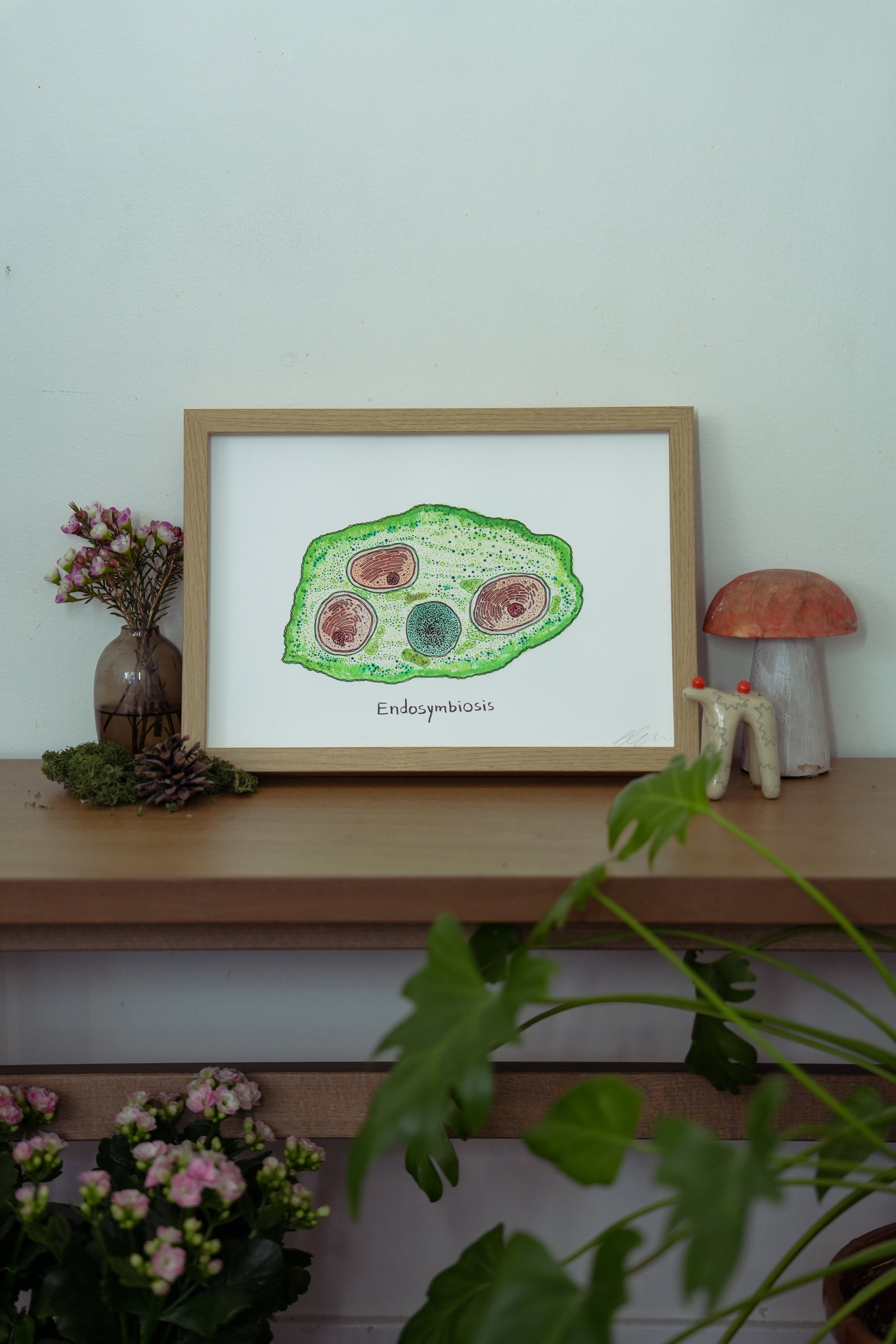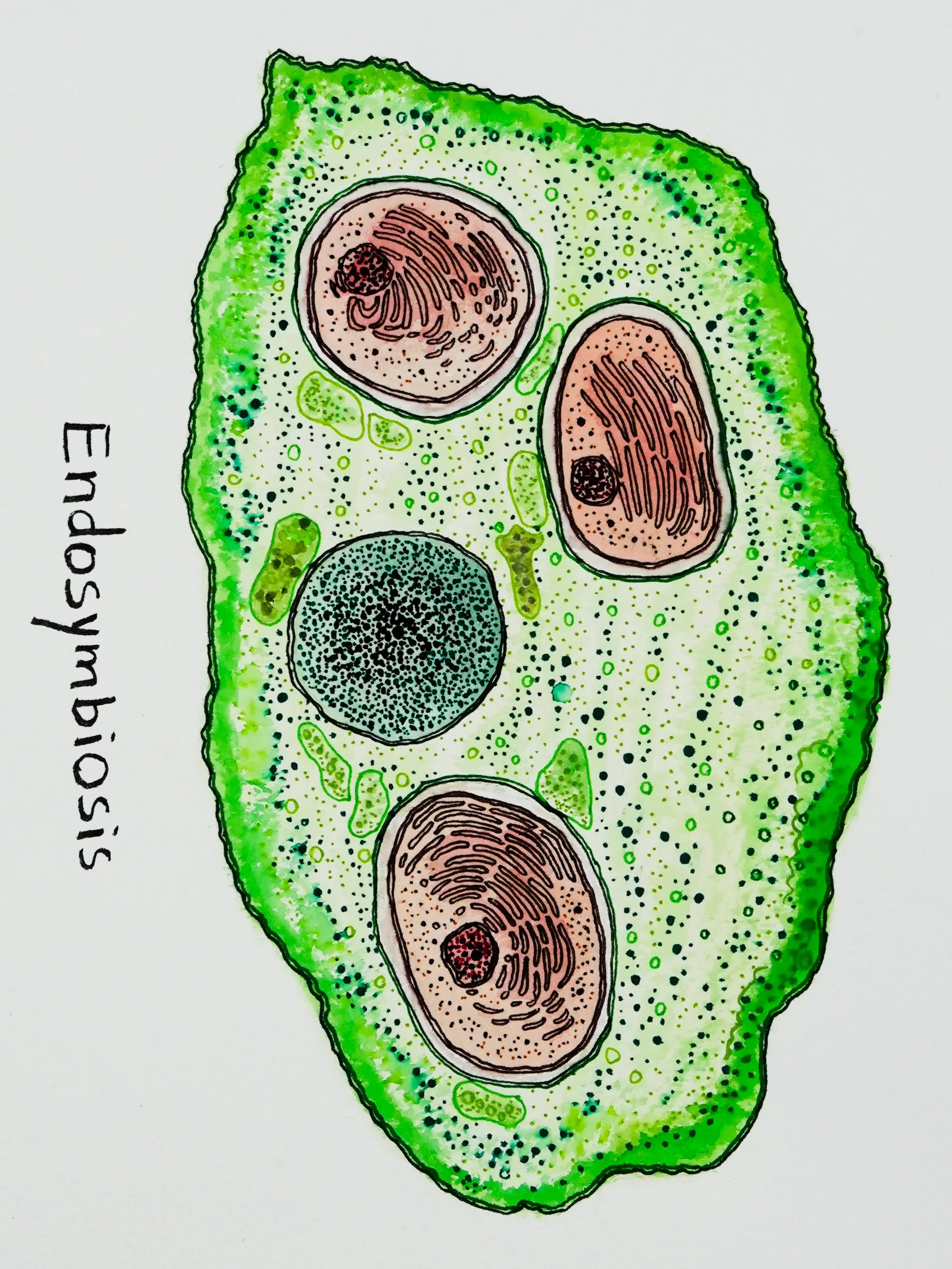
This illustration is inspired by microscopic observations of insect cells harboring Wolbachia, an alphaproteobacterial endosymbiont. It imagines an ancient evolutionary moment — when an early host cell first formed a lasting partnership with an aerobic bacterium, laying one of the most important foundations of complex life.
In 1967, evolutionary biologist Lynn Margulis proposed the endosymbiotic origin of mitochondria. She suggested that mitochondria were once free-living bacteria capable of aerobic metabolism, later incorporated into early eukaryotic cells.
For much of early Earth’s history, oxygen was scarce and life relied on anaerobic metabolism. Around 2.4 billion years ago, the Great Oxidation Event transformed the atmosphere. Oxygen accumulated — toxic to many early organisms, yet advantageous to certain bacteria able to harness it for energy.
When ancestral host cells engulfed these oxygen-using bacteria, a stable symbiosis emerged. Over evolutionary time, this partnership became permanent, giving rise to the mitochondria within our cells today.
When Margulis first proposed this idea, it was considered radical and met with resistance. Decades later, advances in DNA sequencing confirmed that mitochondrial genomes are closely related to Alphaproteobacteria, validating her insight.
This work reflects that turning point — the moment cooperation reshaped life itself.
Artwork size (unframed): 21 × 29.7 cm (A4). Created on cold-pressed watercolor paper with medium grain and high cotton content (50–90%).
Framed size: 21 × 30 cm. Presented in an IKEA RÖDALM frame (oak effect).
This illustration is inspired by microscopic observations of insect cells harboring Wolbachia, an alphaproteobacterial endosymbiont. It imagines an ancient evolutionary moment — when an early host cell first formed a lasting partnership with an aerobic bacterium, laying one of the most important foundations of complex life.
In 1967, evolutionary biologist Lynn Margulis proposed the endosymbiotic origin of mitochondria. She suggested that mitochondria were once free-living bacteria capable of aerobic metabolism, later incorporated into early eukaryotic cells.
For much of early Earth’s history, oxygen was scarce and life relied on anaerobic metabolism. Around 2.4 billion years ago, the Great Oxidation Event transformed the atmosphere. Oxygen accumulated — toxic to many early organisms, yet advantageous to certain bacteria able to harness it for energy.
When ancestral host cells engulfed these oxygen-using bacteria, a stable symbiosis emerged. Over evolutionary time, this partnership became permanent, giving rise to the mitochondria within our cells today.
When Margulis first proposed this idea, it was considered radical and met with resistance. Decades later, advances in DNA sequencing confirmed that mitochondrial genomes are closely related to Alphaproteobacteria, validating her insight.
This work reflects that turning point — the moment cooperation reshaped life itself.
Artwork size (unframed): 21 × 29.7 cm (A4). Created on cold-pressed watercolor paper with medium grain and high cotton content (50–90%).
Framed size: 21 × 30 cm. Presented in an IKEA RÖDALM frame (oak effect).