This illustration explores the blood–brain barrier (BBB) — one of the most selective and protective interfaces in the human body.
The BBB is formed by tightly connected endothelial cells lining brain capillaries. Unlike blood vessels elsewhere in the body, these endothelial cells are sealed by tight junctions, reinforced by pericytes and astrocytic end-feet. Together, they create a highly regulated barrier that shields the brain from toxins, pathogens, and fluctuations in the bloodstream.
Most molecules circulating in the blood cannot freely cross this boundary.
And yet, the barrier is not silence.
While large or harmful substances are blocked, the endothelial cells of the BBB express receptors for many signaling molecules — including histamine, inflammatory mediators, and cytokines. Even when molecules do not physically cross into the brain, their signals can still be sensed, translated, and transmitted inward.
The brain is protected — but it is not isolated.
This work reflects that paradox: a physical barrier that still allows communication. A membrane that filters matter, yet carries meaning. It reminds us that inflammation, stress, and immune activation can shape the brain not by invasion, but by signaling.
A boundary — and a conversation.
Artwork size (unframed): 21 × 29.7 cm (A4). Created on cold-pressed watercolor paper with medium grain and high cotton content (50–90%).
Framed size: 30 × 40 cm. Presented in a black IKEA RÖDALM frame.
This illustration explores the blood–brain barrier (BBB) — one of the most selective and protective interfaces in the human body.
The BBB is formed by tightly connected endothelial cells lining brain capillaries. Unlike blood vessels elsewhere in the body, these endothelial cells are sealed by tight junctions, reinforced by pericytes and astrocytic end-feet. Together, they create a highly regulated barrier that shields the brain from toxins, pathogens, and fluctuations in the bloodstream.
Most molecules circulating in the blood cannot freely cross this boundary.
And yet, the barrier is not silence.
While large or harmful substances are blocked, the endothelial cells of the BBB express receptors for many signaling molecules — including histamine, inflammatory mediators, and cytokines. Even when molecules do not physically cross into the brain, their signals can still be sensed, translated, and transmitted inward.
The brain is protected — but it is not isolated.
This work reflects that paradox: a physical barrier that still allows communication. A membrane that filters matter, yet carries meaning. It reminds us that inflammation, stress, and immune activation can shape the brain not by invasion, but by signaling.
A boundary — and a conversation.
Artwork size (unframed): 21 × 29.7 cm (A4). Created on cold-pressed watercolor paper with medium grain and high cotton content (50–90%).
Framed size: 30 × 40 cm. Presented in a black IKEA RÖDALM frame.
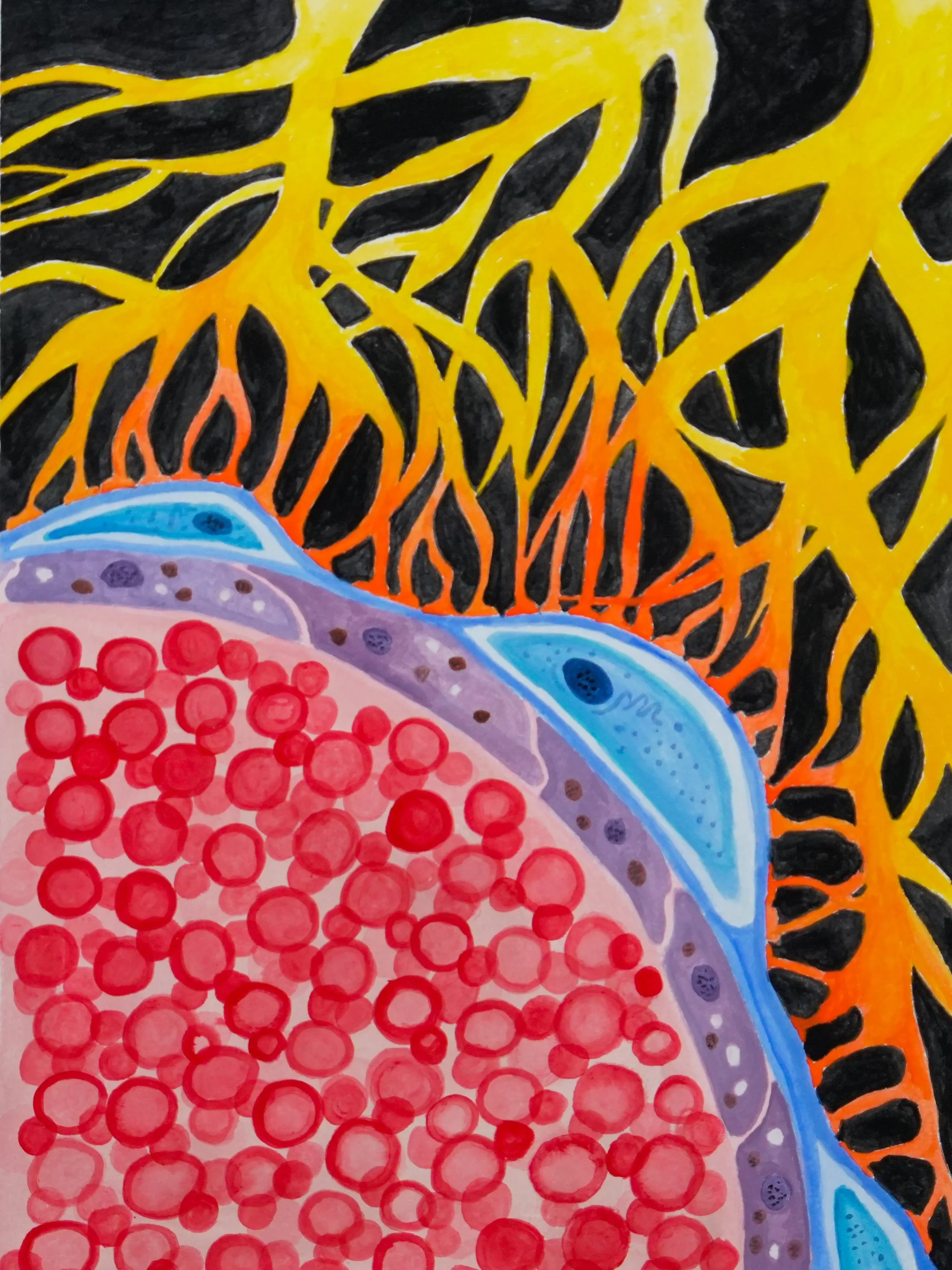 Image 1 of 2
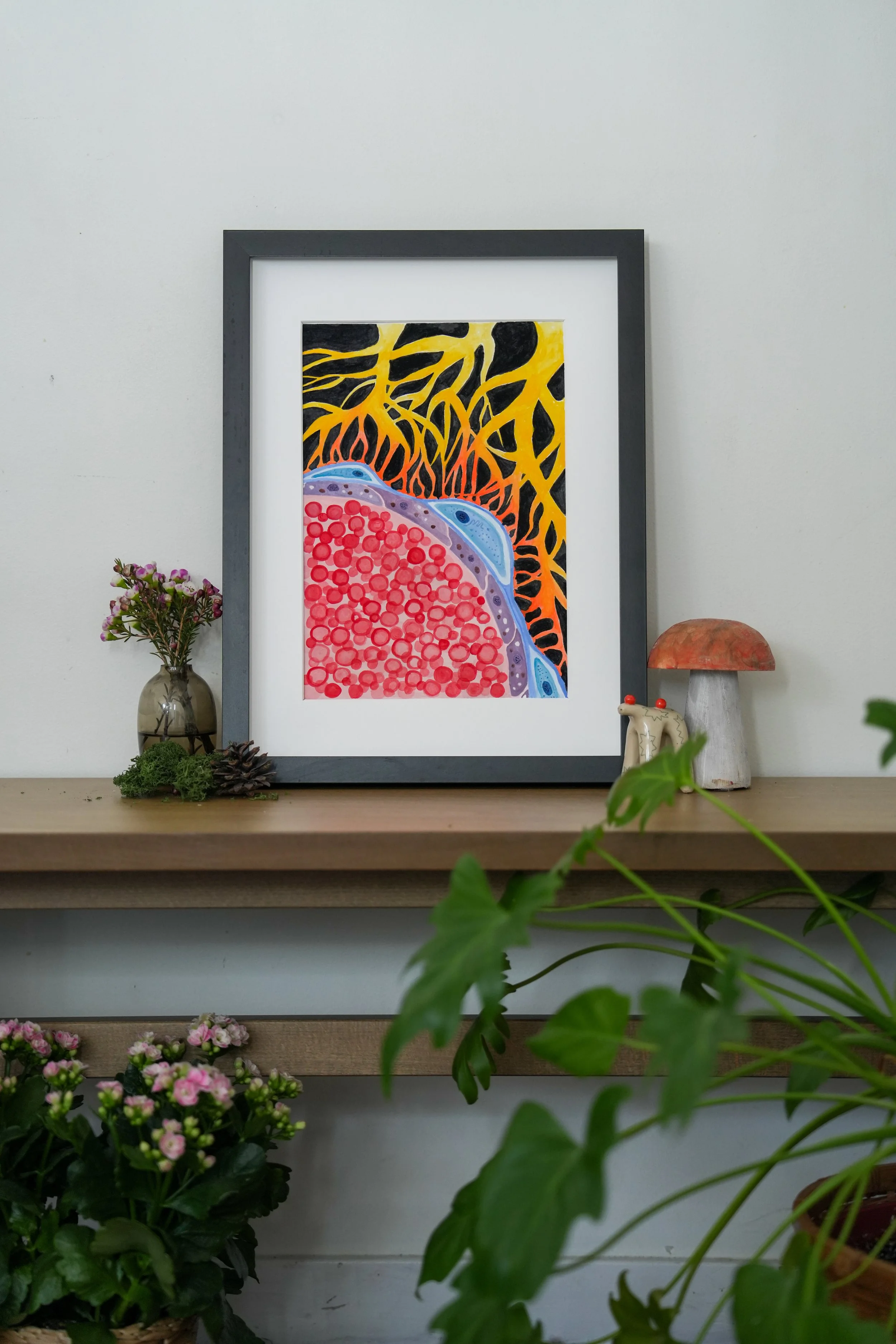 Image 2 of 2